Top Stories
- Veteran Actor Anupam Kher Condemns Brutal Attack on BSF Jawan in Tripura
- State, TTAADC Cannot Develop Tribal Areas Separately: CM
- Newly Appointed TTAADC Members Urged to Stay Honest, Remember Their Roots: Pradyot
- World Bank Hails India’s Water Management Success; Urges Global Sharing Of Jal Jeevan Mission Model Experience
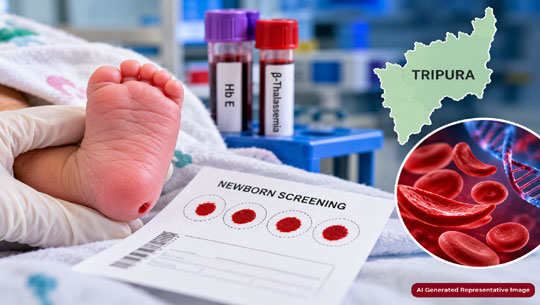
Tripura's Newborn Screening Shows Promise in Early Detection of Blood Disorders
Agartala, Oct 28: Newborn screening programs in Tripura have successfully detected hemoglobin E and beta-thalassemia cases early, according to a new scoping review of 45 studies, which has called for such screening to be expanded across Northeast India. The review was published in the journal Cureus.
The researchers found that Northeast India's blood disorder pattern differs from the rest of the country, with hemoglobin E, rather than beta-thalassemia or sickle cell disease, emerging as the most common variant in the region, including Tripura. It occurs both on its own and in combination with beta-thalassemia, a condition called hemoglobin E-beta-thalassemia, which the review identified as the main cause of serious hemoglobin-related illness locally, with severity ranging from mild anemia to transfusion-dependent cases.
Building on Tripura's screening success, the review suggested that such programs be paired with diagnostic methods and genetic counselling suited specifically to the region, in order to reduce the disease burden over time.
The study also examined tribal communities, finding they bear a heavier share of these disorders due to founder effects and generations of marrying within the same community, alongside added barriers such as remote locations and limited healthcare access.
On genetics, the review found that common beta-thalassemia mutations seen elsewhere in India, including IVS-I-5 and codon 41/42, are present in the Northeast, alongside rare, region-specific mutations that could be missed by standard diagnostic tests.
The authors noted that research remains concentrated in Assam, with Tripura, Meghalaya, Mizoram and Nagaland under-studied, and much of the available data drawn from hospitals rather than the general population. The review was published on August 24, 2026, by a team including researchers from Gauhati Medical College and Hospital.
Recent News